
Why Routine Stool Tests Can Miss Cyclospora—and What Patients Can Ask Their Doctors
Many people assume that a routine stool parasite test automatically checks for every intestinal parasite. In reality, that is not always true.
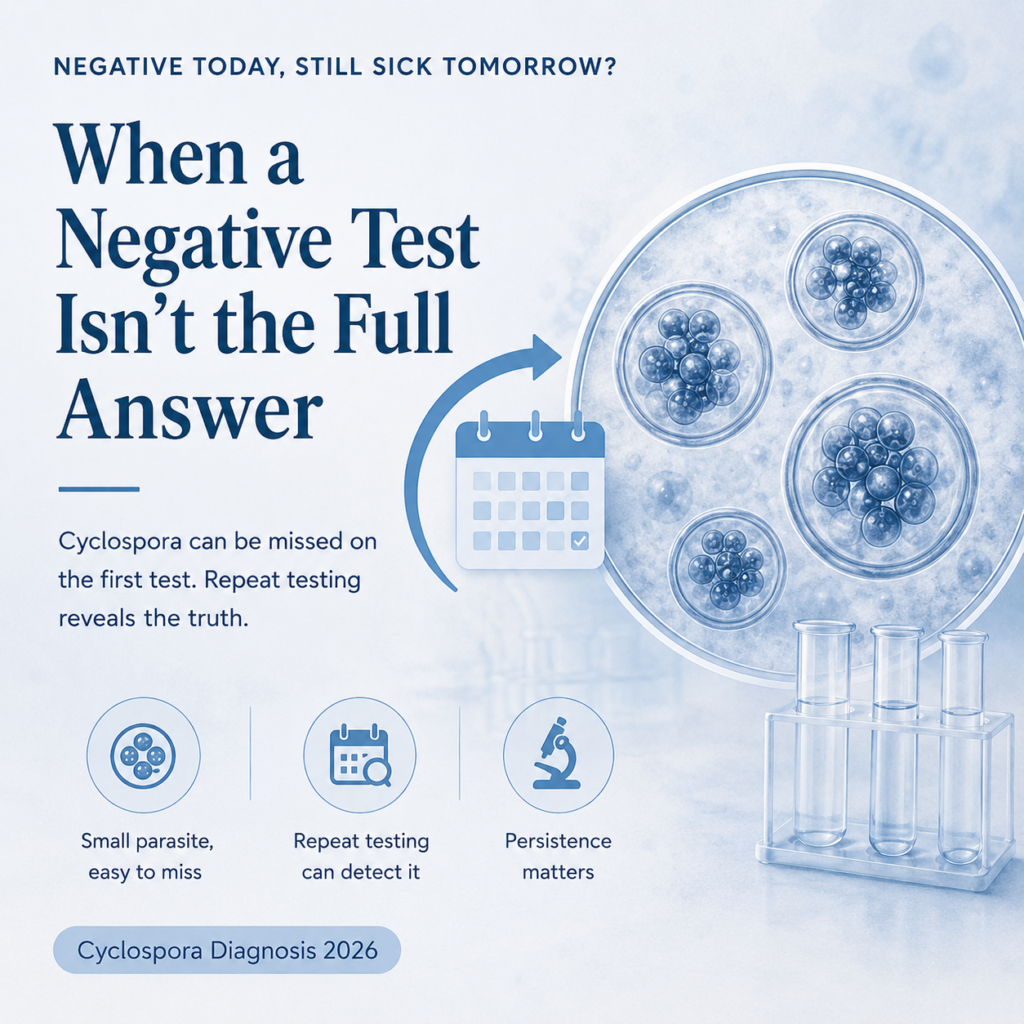
One of the most important messages shared by infectious disease specialists is that a negative routine stool parasite test does not necessarily rule out Cyclospora infection.
Testing for Cyclospora cayetanensis often requires specific laboratory methods, and some routine stool examinations or gastrointestinal PCR panels may not include it unless specifically requested.
If you’re still trying to determine whether your symptoms match this infection, consider reviewing our guide explaining why Cyclospora symptoms may disappear and return over several weeks.
Why a Negative Parasite Test May Not Give the Complete Answer
Many standard stool examinations are designed to detect a range of parasites, but they do not always include Cyclospora.
Because of this, someone may receive a negative parasite result while still having cyclosporiasis.
Healthcare professionals may need to request a Cyclospora-specific test depending on symptoms, travel history, and possible food exposures.
Why Cyclospora Can Be Difficult to Detect
Cyclospora sheds microscopic oocysts inconsistently.
Even during active illness, one stool sample may contain too few organisms for easy laboratory detection.
For that reason:
- A single negative stool sample does not always exclude infection.
- Doctors may recommend collecting multiple stool samples on different days.
- Repeat testing improves the likelihood of identifying the parasite.
Which Laboratory Methods Can Detect Cyclospora?
Laboratories may use one or more specialized testing methods.
| Diagnostic Method | Purpose |
|---|---|
| PCR testing | Detects Cyclospora genetic material. |
| Modified acid-fast stain | Special stain that helps identify Cyclospora oocysts. |
| Modified safranin stain | Alternative staining technique. |
| Ultraviolet fluorescence microscopy | Detects naturally fluorescent Cyclospora oocysts. |
| Stool concentration procedures | Increase the chance of finding small numbers of parasites. |
Patients usually do not need to choose which laboratory method is used.
The more important question is:
“Does the stool test specifically include Cyclospora cayetanensis?”
A Useful Question to Ask Your Healthcare Provider
If watery diarrhea has continued for several days or weeks, patients may ask:
“Does the stool test you ordered specifically include Cyclospora, and would repeat stool samples be appropriate if my first result is negative?”
Providing a detailed exposure history can also help.
Helpful Information to Share
- Recent travel (especially international travel)
- Raw herbs
- Leafy greens
- Bagged salad mixes
- Berries
- Pre-cut fruits and vegetables
- Restaurant garnishes
- Untreated water
- Food eaten during the two weeks before symptoms began
This information may assist both clinical diagnosis and public-health investigations.
What Is the Recommended Treatment?
According to current CDC guidance, the recommended treatment for cyclosporiasis is:
Trimethoprim-Sulfamethoxazole (TMP-SMX)
This medicine is marketed under several brand names including:
- Bactrim
- Septra
- Cotrim
Treatment decisions should always be made by a licensed healthcare professional after considering:
- Laboratory confirmation
- Age
- Pregnancy or breastfeeding
- Kidney function
- Liver function
- Immune status
- Sulfonamide allergy
- Current medications
Commercial Disclosure
Skitesintl.com is a commercial medicine website associated with this publication.
Any medicine information or product availability provided is intended solely for educational purposes and should never be interpreted as advice to self-diagnose, obtain prescription medicines unlawfully, or begin treatment without professional medical supervision.
The CDC also notes that many otherwise healthy individuals may eventually recover without treatment, although symptoms may last longer or return.
Persistent diarrhea or severe illness should always be evaluated by a healthcare professional.
Is Ciprofloxacin the Standard Alternative?
Online discussions sometimes recommend ciprofloxacin for anyone unable to take TMP-SMX.
Current evidence is considerably more cautious.
According to CDC guidance:
- No highly effective alternative has been identified for patients who cannot take TMP-SMX.
- Limited studies suggested ciprofloxacin may have modest activity.
- However, broader clinical experience indicates it is frequently ineffective against Cyclospora.
Depending on the individual patient, healthcare professionals may instead consider:
- Supportive care and observation
- Therapies supported only by limited evidence
- Specialist-supervised TMP-SMX desensitization in carefully selected patients
Desensitization is appropriate only under specialist medical supervision and is not suitable for every allergy.
What If Symptoms Continue After Treatment?
If symptoms persist after completing treatment, further medical evaluation may be needed.
Possible reasons include:
- The diagnosis was incorrect.
- Another infection is also present.
- The medication course was not completed.
- A new exposure occurred.
- The immune system is weakened.
- Post-infectious gastrointestinal symptoms remain.
- Repeat stool testing is appropriate.
Only a qualified healthcare professional can determine which explanation applies.
Hydration Remains Essential
Frequent watery diarrhea can rapidly cause dehydration and electrolyte loss.
Children, older adults, people with chronic illnesses, and immunocompromised individuals may face greater risk of complications.
Seek prompt medical attention if any of the following develop:
- Very little urination
- Severe dry mouth
- Dizziness
- Fainting
- Confusion
- Rapid heartbeat
- Inability to keep fluids down
Severe dehydration requires immediate medical assessment rather than self-treatment.
The Takeaway
A routine negative stool parasite test does not necessarily exclude Cyclospora infection.
Anyone experiencing persistent watery diarrhea should discuss Cyclospora-specific testing with a healthcare professional, especially when symptoms, food history, or travel history suggest possible exposure.
Treatment decisions should always be guided by laboratory findings and professional medical advice—not recommendations shared on social media or online comment sections.
Medical Disclaimer
This article is intended for educational purposes only and does not replace professional medical advice, diagnosis, laboratory testing, or treatment from a licensed healthcare provider. Never start, stop, or change prescription medication without consulting your healthcare professional.