
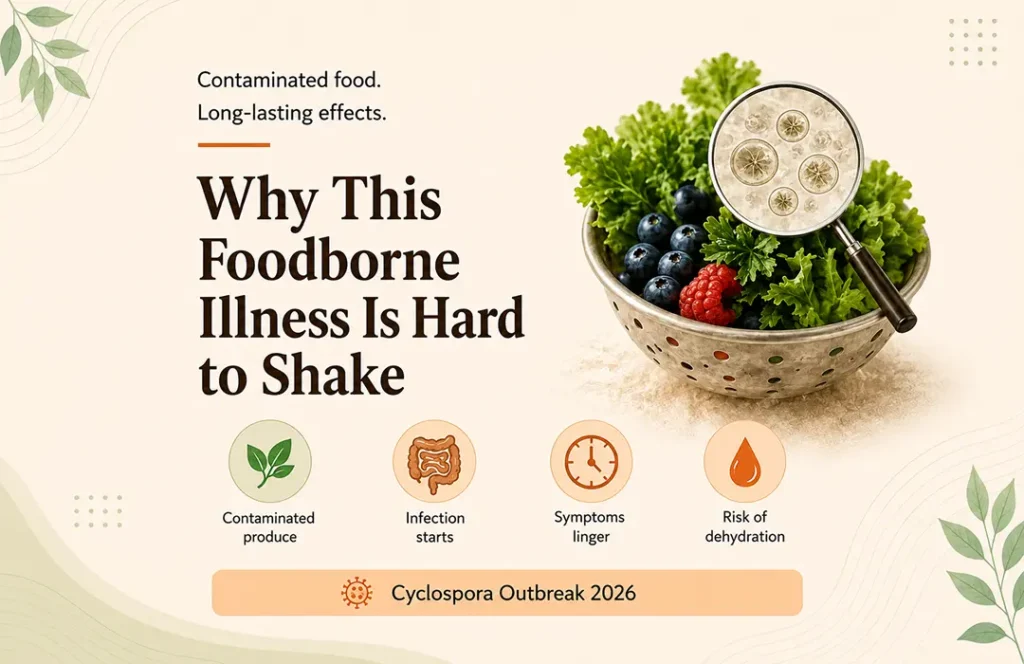
Cyclospora Outbreak 2026: Why Symptoms Can Last for Weeks
Meta description: Learn why Cyclospora can cause recurring diarrhea, fatigue and dehydration for weeks, how the infection spreads, why routine stool tests may miss it and what current medical guidance recommends.
Last updated: July 20, 2026
Across social media, many people are describing a gastrointestinal illness that feels very different from a typical 24-hour stomach bug.
Patients have reported repeated episodes of watery diarrhea, severe fatigue, appetite loss, abdominal discomfort, weight loss and difficulty remaining hydrated. In some cases, symptoms appear to improve temporarily before returning days or even weeks later.
This prolonged and relapsing pattern is a recognized feature of cyclosporiasis, an intestinal infection caused by the microscopic parasite Cyclospora cayetanensis.
CDC Cyclospora Update for 2026
According to CDC surveillance data through July 13, 2026:
- 1,645 laboratory-confirmed domestically acquired cases had been reported.
- Cases had been reported by 34 states.
- 141 people had been hospitalized.
- No deaths had been reported.
The CDC notes that the actual number of infections is probably higher because some people recover without seeking medical care, while others may not receive testing specifically for Cyclospora. The reported figures are preliminary and may continue to increase because of delays between illness onset, diagnosis and reporting.
Iceberg Lettuce Outbreak Investigation
Within the broader national case count, the CDC and FDA have been investigating a five-state outbreak associated through epidemiological and traceback evidence with shredded iceberg lettuce supplied by Taylor Farms de Mexico.
The investigation initially focused on lettuce served at Taco Bell restaurants in Indiana, Kentucky, Michigan, Ohio and West Virginia. On July 17, 2026, Taylor Farms initiated a recall covering iceberg lettuce sourced from central Mexico, including products distributed to retailers, restaurants and food-service customers.
On July 19, the FDA reported that a lettuce sample previously described as positive for Cyclospora had been re-evaluated and should be considered a false-positive result. At that time, there was no confirmed positive product sample. However, the epidemiological investigation and recall remained active, and the FDA continued to advise consumers not to eat recalled lettuce.
This distinction is important: an outbreak may be linked to a suspected food through interviews, purchase records and supply-chain traceback even when laboratory testing has not confirmed the parasite in a specific food sample.
The CDC has also stated that it is investigating other Cyclospora outbreaks and illnesses that are unrelated to the iceberg lettuce investigation.
What Is Cyclospora?
Cyclospora cayetanensis is a microscopic, single-celled parasite that infects the human small intestine.
People become infected after swallowing food or water contaminated with infectious Cyclospora oocysts.
In the United States, previous outbreaks have been connected with different types of fresh produce. However, a food, farm, restaurant or grocery store should not be blamed for a new illness unless public-health investigators have confirmed an association.
Cyclospora differs from many common gastrointestinal infections because it is unlikely to spread directly from one person to another.
After the parasite leaves an infected person in stool, it generally needs at least one to two weeks in the environment to become infectious. This delay makes immediate person-to-person transmission unlikely.
How Long After Exposure Do Symptoms Begin?
Symptoms usually begin approximately one week after a person consumes contaminated food or water.
However, the incubation period can vary. Symptoms may appear as early as two days after exposure or more than two weeks later.
This delay can make it difficult to identify the source of infection.
By the time symptoms begin, a person may have eaten at several restaurants or consumed numerous foods, including:
- Leaf salads
- Fresh herbs
- Berries
- Garnishes
- Pre-cut fruit
- Raw vegetables
- Restaurant meals
- Ready-to-eat produce
Patients who become ill may therefore struggle to remember everything they consumed during the two weeks before symptoms appeared.
What Symptoms Should You Watch For?
Watery diarrhea is the most common symptom of cyclosporiasis.
Other common symptoms include:
- Loss of appetite
- Unintentional weight loss
- Stomach cramps
- Abdominal discomfort
- Bloating
- Increased gas
- Nausea
- Persistent fatigue
Less common symptoms may include:
- Vomiting
- Headache
- Body aches
- Low-grade fever
- Other flu-like symptoms
Some infected people may not develop noticeable symptoms.
Why Can Cyclospora Symptoms Last for Weeks?
Without treatment, cyclosporiasis can continue for several days, several weeks or longer than one month.
A particularly frustrating characteristic of the infection is its relapsing pattern. Diarrhea may improve temporarily and then return one or more times.
Fatigue may also continue after the gastrointestinal symptoms begin to improve.
This pattern can cause people to believe they have developed a new infection when the original illness may not have completely resolved.
Although many otherwise healthy people eventually recover, prolonged diarrhea can lead to:
- Dehydration
- Electrolyte disturbances
- Extreme weakness
- Significant weight loss
- Difficulty performing normal activities
- Hospitalization
People with weakened immune systems or poor overall health may experience a longer or more severe illness.
When Should You Contact a Healthcare Professional?
Medical evaluation should be considered when watery diarrhea lasts for more than several days, particularly when it is accompanied by:
- Persistent fatigue
- Loss of appetite
- Weakness
- Abdominal pain
- Unintentional weight loss
- Symptoms that improve and then return
- Recent consumption of recalled produce
- Recent international travel
Contact a healthcare professional promptly if you are having difficulty remaining hydrated.
Signs of dehydration in adults may include:
- Extreme thirst
- Dry mouth
- Urinating less frequently than usual
- Dark-colored urine
- Fatigue
- Dizziness
Seek urgent medical help if dehydration is accompanied by:
- Confusion
- Fainting
- Lack of urination
- Rapid heartbeat
- Rapid breathing
- Inability to keep fluids down
Diarrhea and vomiting can cause significant fluid loss, and severe dehydration can become life-threatening.
During your medical appointment, tell your healthcare provider about recent:
- Travel
- Restaurant visits
- Leafy salads
- Fresh herbs
- Berries
- Garnishes
- Pre-cut fruits or vegetables
- Recalled foods
This information may help the clinician determine whether testing for Cyclospora is appropriate.
Why Is a Routine Stool Test Not Always Enough?
Cyclospora can be difficult to diagnose.
Routine stool tests do not always include testing specifically for this parasite. Healthcare professionals may need to request Cyclospora testing separately.
Diagnostic methods may include:
- Targeted molecular testing, such as PCR
- Modified acid-fast staining
- Modified safranin staining
- Ultraviolet fluorescence microscopy
- Concentration and microscopic examination of stool specimens
Another challenge is that an infected person may shed only small numbers of oocysts, and shedding may occur intermittently.
For this reason:
- One negative stool sample does not completely exclude Cyclospora.
- Several specimens collected on different days may be needed.
- The laboratory may need to use sensitive recovery and detection methods.
- Persistent symptoms should not automatically be dismissed after one routine negative test.
The CDC recommends that healthcare professionals specifically request Cyclospora testing when the infection is suspected.
What Treatment Is Used for Cyclosporiasis?
Current CDC clinical guidance identifies trimethoprim-sulfamethoxazole And nitazoxanide, commonly abbreviated as TMP-SMX, as the treatment of choice for cyclosporiasis.
The medicine may be sold under brand names including:
- Bactrim
- Septra
- Cotrim
Patients should not begin taking TMP-SMX based only on symptoms or information found online.
Persistent diarrhea can have many possible causes, including bacterial, viral, parasitic and non-infectious conditions. Medical evaluation and appropriate testing help determine whether Cyclospora is responsible.
A healthcare professional must also consider whether TMP-SMX is appropriate based on factors such as:
- Medication allergies
- Age
- Pregnancy
- Breastfeeding
- Kidney or liver problems
- Existing medical conditions
- Other prescription medicines
- Potential drug interactions
The CDC states that no highly effective alternative treatment has been identified for patients who are allergic to or cannot tolerate TMP-SMX. Alternative management therefore requires individualized guidance from a qualified healthcare professional.
Prescription Medicine Information
If a qualified healthcare professional has confirmed cyclosporiasis and prescribed treatment, readers may review prescription medicine and availability information through Skites International.
Commercial disclosure: This is a commercial link. It is provided for informational purposes only and should not be interpreted as medical advice or as encouragement to self-diagnose, self-prescribe, purchase or use prescription medicine without appropriate medical supervision.
What About Ivermectin, Activated Charcoal and Herbal Remedies?
Social media discussions frequently recommend products such as:
- Pumpkin seeds
- Papaya seeds
- Black walnut
- Wormwood
- Cloves
- Oregano oil
- Activated charcoal
- Colloidal silver
- Ivermectin
- Fenbendazole
- General “parasite cleanse” products
These recommendations should be approached cautiously.
The word “antiparasitic” does not mean that a medicine or herb works against every parasite. Different organisms have different biological characteristics and may require completely different treatments.
A product that acts against an intestinal worm, for example, is not automatically effective against Cyclospora, which is a protozoan parasite.
Similarly, personal testimonials cannot establish:
- Whether a person actually had Cyclospora
- Whether the infection was confirmed by laboratory testing
- Whether the remedy eliminated the parasite
- Whether improvement occurred naturally
- Whether another treatment was used simultaneously
- Whether the product is safe for other patients
Ivermectin, fenbendazole, activated charcoal and herbal parasite cleanses are not identified by the CDC as the recommended treatment for cyclosporiasis. TMP-SMX remains the treatment of choice when prescribed appropriately.
Self-treatment may also delay accurate diagnosis, expose a person to side effects or interfere with other medicines.
Always tell your healthcare provider about any prescription medicines, supplements, oils, herbs or alternative products you are taking.
Does “Pre-Washed” Produce Eliminate the Risk?
The claim that “pre-washed produce means nothing” is an oversimplification.
Pre-washing may reduce dirt and some contamination, but it cannot guarantee that produce is free from Cyclospora or other pathogens.
Consumers should:
- Follow active food recalls and public-health alerts.
- Discard recalled products rather than attempting to wash them.
- Wash their hands before and after handling produce.
- Wash fresh fruits and vegetables under running water when appropriate.
- Keep produce separate from potentially contaminated surfaces and utensils.
- Refrigerate cut or prepared produce promptly.
- Clean containers and surfaces that touched recalled food.
- Ask a restaurant about the source of lettuce during an active recall when necessary.
Washing produce may reduce contamination, but it may not completely remove Cyclospora. Recalled food should not be eaten even after washing.
What Should You Do if You Think You Have Cyclospora?
A sensible approach includes:
- Contacting a qualified healthcare professional.
- Explaining how long the symptoms have continued.
- Mentioning whether symptoms improved and then returned.
- Discussing recent food, restaurant and travel exposures.
- Asking whether Cyclospora-specific stool testing is appropriate.
- Submitting additional stool specimens if medically requested.
- Following clinician-guided treatment.
- Maintaining adequate hydration.
- Avoiding unproven or veterinary products.
- Following current recall and public-health information.
Social media can help people recognize that others are experiencing similar symptoms. However, it cannot confirm the cause of an individual illness, determine whether a person has Cyclospora or identify the safest treatment for that person.
The Bottom Line
Cyclospora is not always a brief stomach infection.
Symptoms can continue for weeks, disappear temporarily and then return. Persistent fatigue may continue even after diarrhea begins improving.
Diagnosis may also be delayed because routine stool testing does not always include Cyclospora, and one negative specimen may not completely rule it out.
Anyone experiencing persistent or recurring watery diarrhea—especially with dehydration, weakness, appetite loss or weight loss—should seek medical evaluation.
Accurate diagnosis, Cyclospora-specific testing when appropriate, adequate hydration and clinician-guided treatment provide a safer approach than relying on viral remedies, testimonials or self-prescribed medicines.
Medical Disclaimer
This article is intended for general educational and informational purposes only. It should not be considered medical advice, diagnosis, a prescription or a treatment recommendation.
The information does not replace consultation, examination, laboratory testing or treatment from a licensed healthcare professional.
Always consult a qualified healthcare provider before starting, stopping or changing any prescription medicine, over-the-counter product, supplement, herbal preparation or alternative treatment. Seek urgent medical assistance for severe symptoms, significant dehydration, confusion, fainting, lack of urination or inability to keep fluids down.