
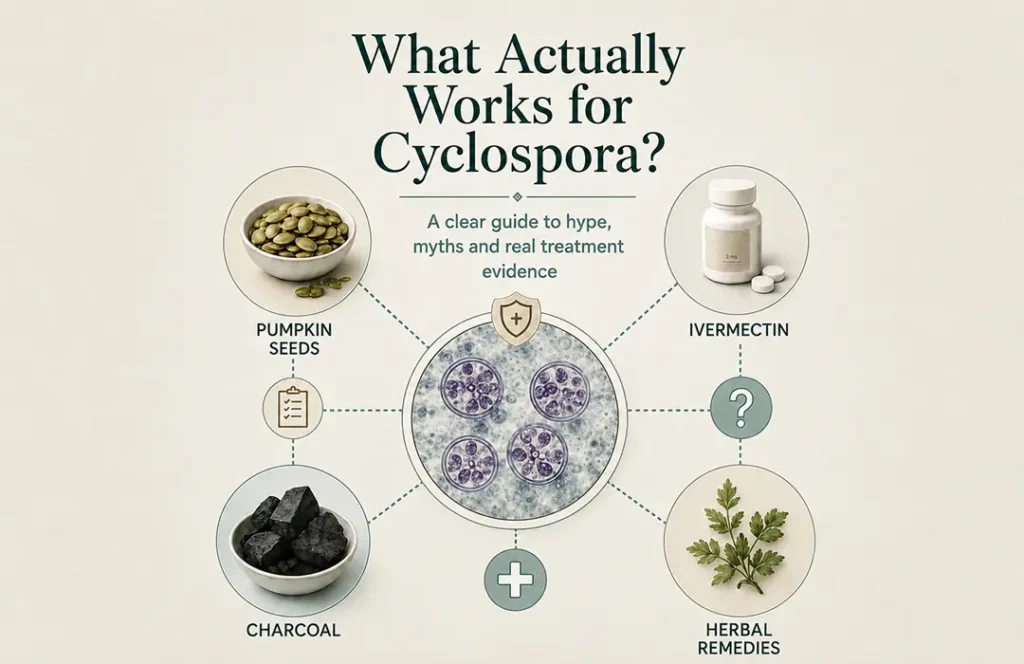
Pumpkin Seeds, Ivermectin and Charcoal for Cyclospora: Separating Claims From Evidence
Social media users are discussing pumpkin seeds, herbal cleanses, ivermectin, fenbendazole, activated charcoal and colloidal silver for Cyclospora infection.
This article examines these popular claims and explains what current medical evidence and public health guidance actually support.
Why Alternative Cyclospora Remedies Are Trending
Cyclospora infection can cause prolonged watery diarrhoea, abdominal discomfort, fatigue, loss of appetite and weakness. Symptoms may temporarily improve and then return, making the illness especially frustrating for patients.
When symptoms continue for days or weeks, many people understandably begin searching online for anything that promises faster relief.
Frequently discussed remedies include:
- Pumpkin seeds
- Papaya seeds
- Cloves
- Oregano oil
- Black walnut
- Wormwood
- Activated charcoal
- Colloidal silver
- Ivermectin
- Fenbendazole
Although these discussions reflect genuine concern, personal testimonials do not establish that a product can eliminate Cyclospora cayetanensis.
Before trying remedies recommended online, it is important to understand what current clinical guidance recommends.
What Current Medical Guidance Recommends
The CDC identifies trimethoprim-sulfamethoxazole And nitazoxanide , commonly abbreviated as TMP-SMX, as the treatment of choice for cyclosporiasis.
It may be marketed under brand names including:
- Bactrim
- Septra
- Cotrim
Patients should not begin taking TMP-SMX without medical evaluation and a prescription.
Persistent diarrhoea can have many possible causes, and a healthcare professional may need to request testing specifically for Cyclospora. Not all routine stool tests or gastrointestinal PCR panels automatically test for this parasite.
Whether TMP-SMX is appropriate can also depend on factors such as:
- Age
- Medical history
- Kidney or liver problems
- Pregnancy or breastfeeding
- Medication interactions
- Sulfonamide allergy
The CDC notes that no highly effective alternative treatment has yet been identified for people who cannot tolerate TMP-SMX. Patients with a sulfonamide allergy should therefore discuss their individual options with a qualified healthcare professional rather than selecting an alternative antibiotic themselves.
Commercial Disclosure
If a qualified healthcare professional has confirmed cyclosporiasis and prescribed treatment, readers may review prescription medicine and availability information through Skites International.
This is a commercial link. It is provided for informational purposes only and should not be interpreted as medical advice or as encouragement to self-diagnose, self-prescribe, purchase or use prescription medicine without appropriate medical supervision.
Claim: Raw Pumpkin Seeds Kill Cyclospora
Pumpkin seeds are nutritious and may be included as part of a balanced diet. However, they are not identified in current CDC clinical guidance as a treatment for cyclosporiasis.
Evidence involving laboratory experiments, plants or different types of parasites cannot automatically be applied to Cyclospora infection in humans.
Some people may report feeling better while eating pumpkin seeds, but improvement during recovery does not prove that the seeds eliminated the parasite. Cyclospora symptoms can naturally improve and then return during the course of the illness.
Verdict: Pumpkin seeds can be consumed as food, but they should not be presented as a scientifically established treatment for Cyclospora.
Claim: Black Walnut, Wormwood, Cloves or Oregano Oil Can Replace Prescription Treatment
Many products marketed as “parasite cleanses” imply that all parasites respond to the same herbs or oils.
In reality, different parasites have different biological characteristics and respond to different treatments. A substance that affects one organism in a laboratory may have no meaningful effect against Cyclospora in the human intestine.
Black walnut, wormwood, cloves and oregano oil are not established treatments for cyclosporiasis in current CDC clinical guidance.
Herbal products may also vary in concentration and may interact with medicines or cause adverse effects. Patients should tell their healthcare providers about any supplements, oils or herbal preparations they use.
Verdict: Current clinical guidance does not support these herbal products as replacements for appropriate Cyclospora testing and medical care.
Claim: Ivermectin Works Because It Is an Antiparasitic Medicine
The word “antiparasitic” covers many medicines that act against different organisms.
A medicine that works against one type of parasite does not automatically work against every parasitic infection.
Current CDC clinical guidance identifies TMP-SMX as the treatment of choice for cyclosporiasis and does not list ivermectin as a treatment for the infection.
Taking prescription medicines without an accurate diagnosis can expose a person to unnecessary side effects, interactions and delays in receiving appropriate care.
Verdict: Ivermectin is not an established CDC-recommended treatment for Cyclospora infection.
Claim: Fenbendazole or the Joe Tippens Protocol Eliminates Cyclospora
Fenbendazole is used in veterinary medicine to treat certain parasitic worms in animals.
It is not an established human treatment for Cyclospora infection. Cyclospora is a protozoan parasite, not one of the intestinal worms for which veterinary fenbendazole products are commonly formulated.
Veterinary products may also have formulations, concentrations and quality controls intended specifically for animals.
Verdict: Veterinary fenbendazole products should not be used to self-treat suspected or confirmed cyclosporiasis.
Claim: Activated Charcoal Removes Cyclospora or Its “Toxins”
Activated charcoal has recognized medical uses in certain poisoning situations, generally under professional guidance.
However, it is not included in current CDC treatment guidance for cyclosporiasis, and there is no established evidence that it removes Cyclospora from the intestinal tract.
Activated charcoal may also interfere with the absorption of medicines taken around the same time.
Verdict: Activated charcoal is not an established treatment for Cyclospora infection.
Claim: Colloidal Silver Is a Natural Antimicrobial Treatment
Colloidal silver is promoted online for many unrelated medical conditions.
However, the FDA does not recognize over-the-counter colloidal silver products as safe and effective for treating or preventing disease. Using colloidal silver may also cause adverse effects and interfere with certain medicines.
Verdict: Colloidal silver is not an evidence-based treatment for Cyclospora and should not replace appropriate medical care.
Does “Pre-Washed” Produce Still Need to Be Washed?
The statement that “pre-washed produce means nothing” is an oversimplification.
Current CDC guidance recommends thoroughly washing fruits and vegetables under running water before eating, cutting or cooking them, even when the packaging says the produce has been pre-washed.
However, washing alone cannot guarantee complete removal of Cyclospora. The CDC states that cooking produce to at least 70°C, or 158°F, can kill the parasite.
Consumers should also:
- Follow official food recall notices.
- Prepare produce according to package directions.
- Wash their hands before and after handling raw produce.
- Keep produce away from contaminated surfaces and utensils.
- Refrigerate cut, peeled or cooked produce promptly.
- Avoid blaming a particular store, farm or producer unless public health authorities have confirmed the source.
How Responsible Health Websites Should Discuss Alternative Remedies
A responsible health resource can acknowledge remedies that are trending online without presenting them as proven treatments.
Public interest does not equal scientific evidence.
Individual testimonials can generate useful questions, but they cannot establish whether a remedy is effective, what dose would be appropriate or whether the product is safe.
Treatment decisions should be based on:
- Accurate diagnosis
- Appropriate laboratory testing
- Current clinical evidence
- The patient’s medical history
- Guidance from a qualified healthcare professional
The Bottom Line
Pumpkin seeds, herbal parasite cleanses, ivermectin, fenbendazole, activated charcoal and colloidal silver are widely discussed in social media communities.
However, current medical guidance does not recognize these products as established treatments for Cyclospora infection.
Persistent watery diarrhoea, dehydration, weakness or recurring gastrointestinal symptoms should be evaluated by a healthcare professional. A clinician can determine whether Cyclospora-specific testing is necessary and recommend treatment based on the diagnosis and the patient’s individual medical circumstances.
Readers who have already received a confirmed diagnosis and prescription from a qualified healthcare professional may review prescribed medicine information through Skites International. Medical evaluation should always come before obtaining or using prescription treatment.
Medical Disclaimer
This article is intended for general educational purposes only and should not be considered medical advice.
It does not replace professional evaluation, diagnosis, laboratory testing or treatment from a licensed healthcare professional. Always consult a qualified healthcare provider before starting, stopping or changing any prescription medicine, over-the-counter product, supplement or herbal preparation.